SEO
How long does SEO take to work?
An honest SEO results timeline for a small business: what happens in the first weeks, at three months and after a year, and how to tell it’s working.

“How long does SEO take?” is the question I get asked most, usually just before “is SEO worth it?”. The honest answer is “it depends”, which is annoying, so I’ll try to be a bit more useful than that.
For most of the small businesses I work with, the first signs show up within a few months, and the part you actually care about (enquiries) builds over six months to a year. Some sites move faster. Some take longer. Here’s roughly what happens along the way, what changes the pace, and how to tell it’s working long before the phone starts ringing.
A rough SEO results timeline
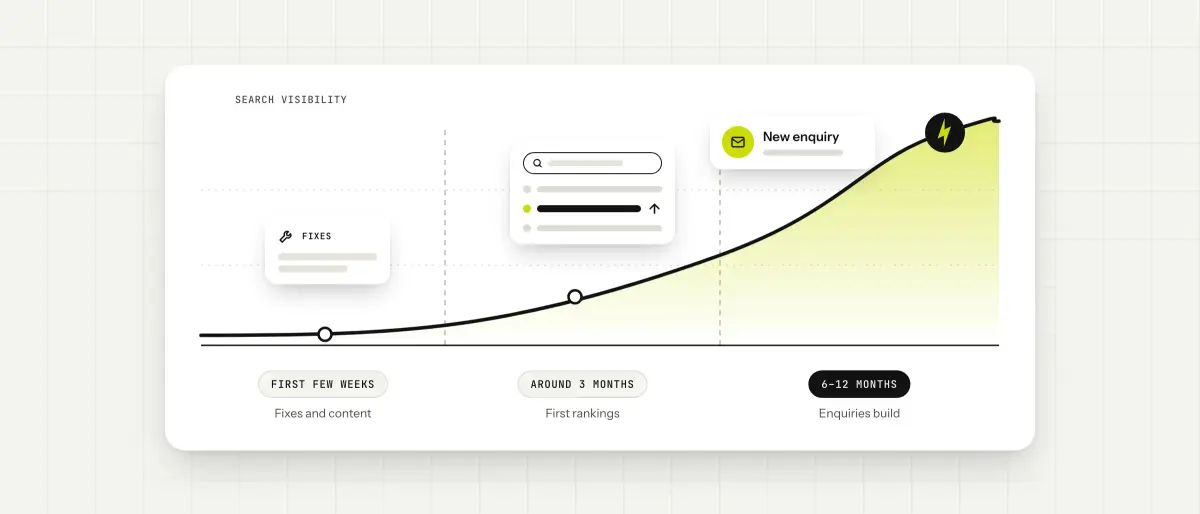
This is what usually happens, not a promise. Every site starts from a different place, and how crowded your corner of Google is makes a big difference. But it’s a fair picture of how it tends to go.
| Timeframe | What’s happening | What you’ll notice |
|---|---|---|
| First few weeks | Technical fixes, page titles, your Google Business Profile tidied up. Google re-crawls (revisits and re-reads) your pages. | Not much, honestly. Maybe a few errors clearing in Search Console. |
| Around 3 months | New and improved pages settle in, and Google starts trying them out for more searches. | More impressions in Search Console and early rankings for longer, more specific searches. |
| 6–12 months | Content, reviews and links build up, and rankings steady. | Steadier positions for the searches that matter, more visits and more enquiries. |
| After a year | Ongoing content and upkeep. | Pages that keep bringing people in without you paying for each click. |
The first few weeks feel slow because most of the work is invisible. I’m fixing the things Google has been tripping over, then waiting for it to come back and notice. Google doesn’t re-read your whole site the moment you change something. It visits on its own schedule, and on a small site that can take a while.
What speeds SEO up
A few things make a real difference to how quickly you see results.
A sound technical setup: if your site is fast, works properly on phones and Google can read every page easily, the rest of the work gets credit sooner. If it’s slow, or half the pages are hidden from Google, you’re pushing uphill.
Local SEO: for a business that serves an area, the map results are often the quickest win. A complete Google Business Profile, consistent contact details and a steady trickle of reviews can move things in weeks rather than months.
Realistic search terms: “accountant Leeds” is crowded. “Accountant for sole traders in Leeds” is far less so. Specific searches move first, and the people typing them usually know exactly what they want.
Pages that answer the question: a service page that explains what you do, who it’s for, roughly what it costs and what happens next will beat a thin page of buzzwords.
Reviews: they help you rank in local results, and they help people pick you once they’ve found you.
What slows it down
A new domain: a brand new website has no history and nobody linking to it yet. Google is cautious with new sites, so expect the slower end of the timeline.
Competitive keywords: if you’re up against national brands or firms who’ve been at this for years, it takes longer, and some searches may never be worth chasing.
Thin pages: lots of near-identical pages (the same text with a different town name dropped in) tend to do more harm than good.
A site migration done badly: a redesign that changes every web address without redirects can wipe out years of rankings overnight.
That last one is the one I see most. Someone gets a lovely new site, their traffic halves, and nobody connects the two for months. If a redesign is on the cards, ask whoever is building it how they’ll handle redirects before anything goes live.
How to tell SEO is working before the phone rings
Enquiries are the point, but they’re the last thing to move. There are earlier signs, and you can see most of them yourself in Google Search Console, Google’s free tool that shows how your site appears in search.
Impressions going up: an impression is each time your site appears in someone’s results, even if they don’t click. It’s usually the first number to rise, often well before clicks do.
Clicks following: once you’re showing up more often, and higher up, more people click through.
More search terms: Search Console lists the searches you appear for. On a healthy site that list keeps growing, especially with longer, specific phrases.
Long-tail rankings: you’ll often rank for something like “boiler repair Horsforth” well before “plumber Leeds”. That’s normal, and it’s a good sign.
Your Google Business Profile: for local businesses, more calls, direction requests and website clicks from your listing. It has its own simple stats.
When we look after a site’s SEO, I report on these every month and tie them back to enquiries where I can, so you’re not just staring at a graph and hoping.
Red flags to watch for
Because SEO is slow and hard to see, it attracts some confident nonsense. Be wary of anyone who:
Guarantees a #1 ranking. Nobody controls Google’s results, so nobody can promise a position.
Promises results in two weeks. Quick technical fixes can show up fast, but page one for a competitive search in a fortnight is either a guess or something risky.
Sells links by the thousand. Cheap links in bulk can get a site penalised, and undoing that is slow.
Reports rankings for searches nobody makes. Being top for a phrase with no searches is easy and useless.
Won’t say what they’re doing each month. You should know what you’re paying for.
A good SEO person can tell you what they’re doing, why, and what they expect to change. If they can’t explain it in plain English, ask again.
Is SEO worth it for a small business?
Usually, yes, if you go in with the right expectations. The big thing SEO has over paid ads is that it keeps working. When you stop paying for ads, the visits stop the same day. Pages that rank keep bringing people in for months or years after the work is done.
It isn’t right for everyone, though. If you need enquiries next week, ads or ringing round past customers will do more. If your business lives or dies on one fiercely contested search, the cost may outweigh the return. And if your website doesn’t turn visitors into enquiries, fix that first. More traffic to a site that doesn’t convert won’t help.
For most local businesses with a decent site and a clear service, I think SEO is one of the better long-term investments going. Give it six months before you judge it, and judge it on the right numbers. That’s also why our SEO plans start with an initial three-month period: it’s the shortest stretch in which the work can fairly show what it’s doing. After that they roll monthly, and you can stop whenever you like.
Written by Ash
Ash is a senior full-stack developer based in West Yorkshire, working mainly in Laravel and Vue. He leads development and SEO at Shock Creative, and likes nothing more than a fast, properly built website that turns up in search and wins enquiries. More about us